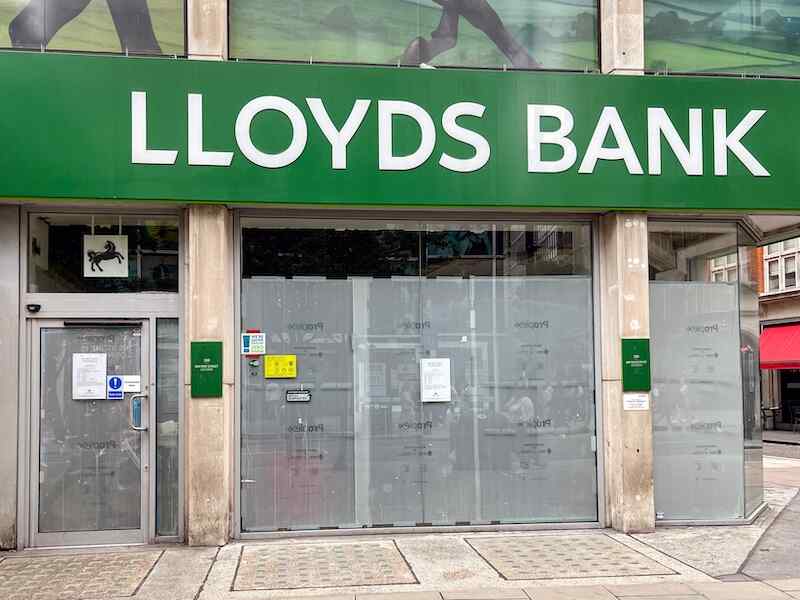
The closing down of high-street bank locations continues, with the Lloyd Banking Group to axe 60 more high-street branches between June and September of this year.
The banking group attributed the latest wave of closures, involving 24 Lloyds Bank, 19 Bank of Scotland, and 17 Halifax branches, to the growing customer preference for digital banking. Lloyds said that across its brands has 18.6 million regular online banking customers and 15 million mobile app users - up 12% and 27% respectively over the past two years.
Vim Maru, group retail director, said: “Just like many other high street businesses, fewer customers are choosing to visit our branches.
“Our branch network is an important way for us to support our customers, but we need to adapt to the significant growth in customers choosing to do most of their everyday banking online.”
Lloyds previously closed 100 locations in 2021 and is due to have shuttered another 48 by April of this year. The latest round of closures will take its branch network to 1,476 locations.
In three locations where Lloyds will shut branches - Buckingham, Cottingham, and Troon - shared banking hubs are due to open, allowing customers of all major UK banks to carry out basic banking tasks. Lloyds says it will continue to operate in those locations until the shared hubs open.
The 60 closures will also result in 124 job losses, Unite said. A Lloyds spokesperson did not deny that there would be job losses but said it was making efforts to offer the affected employees positions at other locations.
But Caren Evans, national officer for the union, said that Lloyds should “should not be allowed to abandon 60 more local communities where bank branches play an essential role.”
The 124 staff who will lose their jobs are “dedicated to serving the banking needs of the most vulnerable who depend on their skilled services,” she said.
“Unite is clear that simply leaving an ATM in place of a vibrant bank branch is wholly insufficient,” she added.
"The banking sector needs to answer some serious questions about its corporate social responsibilities and the government cannot stand back and allow the relentless closure of banks to continue until no more local banking services remain.”
The government has previously pointed to the introduction of shared banking hubs, the availability of basic banking services at the Post Office, and rule changes that allow people to get cashback without a purchase at high street shops as alternatives that mitigate the impact of branch closures.
In September 2020, the Financial Conduct Authority (FCA) published guidance requiring banks to notify it of planned closures and detail their impact on customers and alternatives available to them. However, the requirements haven’t slowed the pace of branch closures: 736 were retired in 2021.
Planned Closures
Lloyds Bank Branches:
Aylesbury Gatehouse
Beaconsfield
Birmingham Temple Row
Bolton Westhoughton
Bradford Thornbury
Buckingham
Chandlers Ford
Chipping Campden
Colchester St Johns
Cottingham
Edgbaston
Knutsford
Liverpool Woolton
Lyndhurst
Marlow
Morriston Swansea
Oxford Summertown
Poulton-le-Fylde
Rushden
Shanklin
Shrewsbury Mount Pleasant
Smethwick
Swanwick
Tiptree
Halifax branches:
Abingdon
Beaconsfield
Beccles
Belfast Shaftesbury
Bideford
Devizes
Doncaster Mkt Pl
Dunstable
Finchley Central
Halifax Commercial St, Margate
Morriston
Penge
Totton
Wokingham
Worcester Park
Yeadon
Bank of Scotland branches:
Aberdeen 201 Union St
Alness
Brechin
Broxburn
Carluke
Clarkston
Dunblane
Dyce
Edinburgh Barnton
Edinburgh Shandwick
Forres
Glasgow Riddrie
Innerleithen
Kirkcudbright
Lockerbie
Selkirk
Shotts
Stromness
Troon